From Knowledge to Harvest: How Sasakawa Is Changing Smallholder Farming in Benue
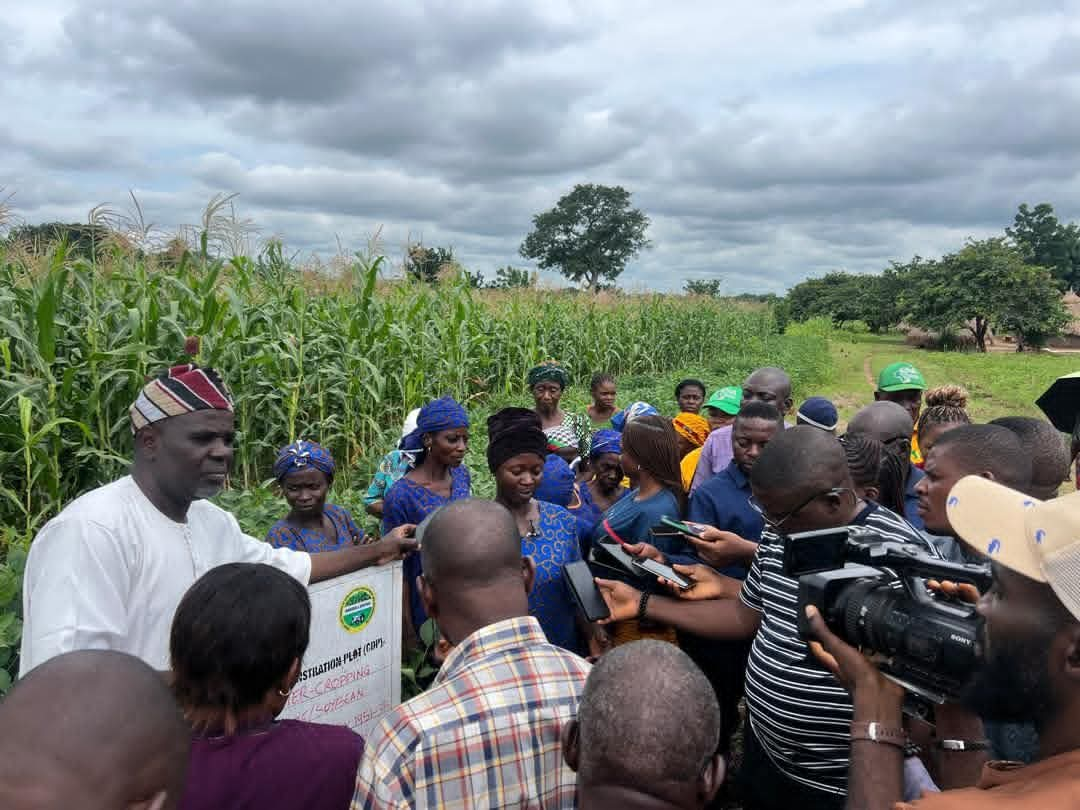
Smallholder farmers in Benue State are adopting improved farming practices through a three-year intervention of the Sasakawa Africa Association Nigeria (SAA-NIG), supported by Japan’s Nippon Foundation and implemented in partnership with the Benue State Government.
During a
two-day media field tour organised with the participation of the Benue State Bureau for International Cooperation
and Development (BICD), farmers demonstrated how the programme
is turning technical knowledge into practical changes in their fields,
businesses and livelihoods.
For a
state widely regarded as Nigeria’s Food Basket, the intervention extends beyond
individual farms to eight Local Government Areas—Guma, Gwer, Gboko, Ushongo,
Vandeikya, Tarka, Buruku and Konshisha—and combines regenerative agriculture,
nutrition-sensitive farming and market-oriented approaches to improve soil
health, seed access, processing and market opportunities.
The
programme is ultimately about helping smallholder farmers produce more
efficiently, build resilience, improve the value of what they produce and
acquire knowledge they can continue to use beyond the lifespan of the
intervention.
At one
demonstration farm, farmers were learning crop rotation, intercropping,
composting, biochar production and the use of urea supergranules to improve
soil health and use fertiliser more efficiently.
One
farmer, Rona Andove Bata, said she was initially reluctant to participate. But
after adopting the practices introduced by Sasakawa, she began to see the
benefits.
“I did
not spend one naira. Everything was supplied,” she said, explaining that she
prepared biochar and compost manure before planting and followed the technical
guidance provided.
Her
experience reflects the programme’s emphasis on more than simply providing
inputs. Farmers are taught how to use and sustain the technologies and
practices themselves, helping to ensure that knowledge remains within their
communities long after individual activities have ended.
In
Buruku, that approach extends to seed production. Farmers are cultivating a
community-based soybean seed multiplication plot using the improved TGX 1951-3F
variety, bringing quality seed closer to surrounding farming communities.
The
farmers receive training in production, enterprise management and record-keeping,
while the seeds undergo the relevant certification process. By strengthening
local seed production, the initiative is helping farmers move beyond being only
recipients of improved planting materials towards becoming part of the system
that produces and distributes them.
In Gwer,
the intervention moves further along the agricultural value chain.
An
improved cassava agro-processing centre established under SAA-NIG’s Safe,
Adequate and Nutritious Food Production and Utilisation programme provides a
five-ton-per-hour cassava grater, hydraulic presses, heavy-duty fryers and a
solar-powered borehole.
For
farmers who once travelled several kilometres to access processing facilities,
the centre is helping reduce transportation costs, ease processing and create
opportunities to earn greater value from their produce.
SAA-NIG
also encourages farmers to see agriculture as a business.
Through
farmer groups and cooperatives, they receive training in collective action,
enterprise management, record-keeping and market linkages, helping them better
understand not only how to produce, but also where and how their products can
be sold. This is supported by the provision of machinery, including tractors to
facilitate large-scale land cultivation.
The
intervention also works through public agricultural extension infrastructure,
with extension agents supporting the delivery of technical knowledge to farmers
at the community level. This helps ensure that knowledge and improved practices
can continue to reach farmers beyond the immediate project cycle.
For
BICD, the field engagement provided an opportunity to strengthen
government-partner relations, observe the practical outcomes of the
intervention and ensure that development support remains aligned with
government priorities and the needs of farming communities.
Through
its coordination role, BICD is supporting the Benue State Government under the
Benue State Governor, Rev. Fr. Hyacinth Iormem Alia (PhD) to maintain an enabling environment in
which development partners can work effectively.
SAA-NIG
Communication Officer, Moses Nongoatse, commended the Benue State Government
for providing a conducive environment for the organisation’s operations and
acknowledged BICD’s coordination role. He said the organisation remains open to
expanding its interventions to additional Local Government Areas, subject to
available resources and counterpart support.
The experience highlights that sustainable
agriculture is not only about what farmers receive, but what they learn, build
and can carry forward into the next season.
Julie Okenyi
Information Officer, BIDC

Comments 0
Join the discussion on this news article. All comments are moderated before appearing.
No comments yet
Be the first to share your thoughts on this story!
Write the first commentLeave a Comment
Your email address will never be published or shared. Required fields are marked *