A theatre born beneath the moonlight
On a typical evening in Tivland, after the day’s work on the farm, families once gathered around the warmth of a fire to listen to stories told by elders. Under the moonlit sky, these storytellers transported their listeners into worlds populated by clever animals, mysterious beings, courageous men and women, greed, betrayal, love, justice and the consequences of human choices.
These gatherings were more than a pastime. They were informal schools where children learnt the values of their society, absorbed the wisdom of their elders and discovered the histories, beliefs and customs of their people.
From this storytelling tradition emerged one of Nigeria’s most distinctive theatrical expressions: Kwagh-Hir, a remarkable cultural heritage of the Tiv people of Benue State that has grown from intimate family storytelling into an elaborate performance combining puppetry, masquerading, music, dance, poetry and dramatic storytelling.
The Tiv expression Kwagh-Hir is commonly translated as “something magical” or “something marvellous”. The name captures the wonder associated with the performance, where carved figures move, masquerades command attention, musicians set the rhythm and stories unfold through a fusion of sound, movement and visual spectacle.
According to the United Nations Educational, Scientific and Cultural Organization (UNESCO), Kwagh-Hir evolved from kwagh-alom, the traditional Tiv practice of evening storytelling. As creative storytellers began dramatising their narratives, the tradition developed into the composite theatrical art form recognised today.
From oral tradition to total theatre
The evolution of Kwagh-Hir demonstrates how a community can transform its oral traditions into an enduring form of artistic expression.
In its traditional setting, stories were conveyed primarily through speech, gestures, humour and the expressive skills of the narrator. As the art form developed, performers introduced carved puppets, elaborate masks, masquerades, music and choreographed movements, giving physical form to characters and events that had previously existed mainly in the imagination of listeners.
The modern form became prominent in the 1960s, with oral accounts associating its development with performers and innovators in Tiv communities, including Adikpo Songo of Akpagher in the Mbatyav area of present-day Gboko Local Government Area. While such accounts acknowledge important pioneers, the evolution of Kwagh-Hir is best understood as a creative process shaped by the wider community and successive generations of practitioners.
What distinguishes Kwagh-Hir is its character as total theatre. Rather than relying on dialogue alone, it combines several artistic disciplines to create a complete dramatic experience.
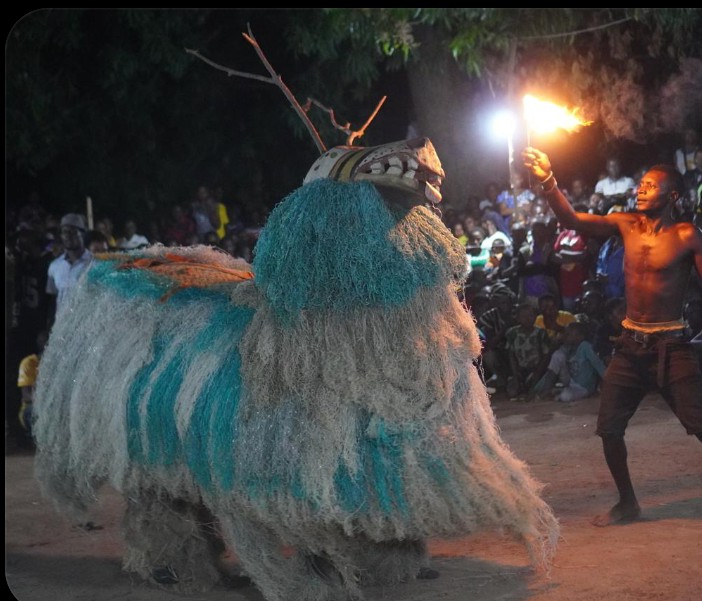
A single performance may feature intricately carved wooden figures, animated puppets, colourful masquerades, live drumming, songs, dance, poetry and humorous dramatic episodes. Through these elements, performers recreate scenes from everyday life, interpret traditional beliefs and bring social experiences to the stage.
The result is a theatrical language in which movement, music, costume, imagery and spoken words work together to communicate ideas and emotions.
The magic behind the performance
For audiences encountering Kwagh-Hir for the first time, its visual spectacle is often the most immediate attraction. Yet behind the colourful display lies considerable artistic skill, planning and cooperation.
The puppets and masks are carefully crafted, with sculptors drawing on their knowledge of form, movement, symbolism and traditional aesthetics. Some figures portray human characters, while others represent animals, unusual beings and exaggerated versions of people encountered in society. Their movements and appearances help turn familiar experiences into compelling dramatic scenes.
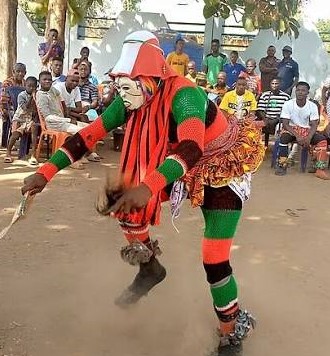
Masquerades add another dimension to the performance. Through costumes, masks, rhythmic movements and carefully choreographed entrances, performers create characters that can be comic, mysterious, intimidating or celebratory.
Music provides the pulse of the production. Drummers establish rhythms, singers carry the narrative and performers respond to musical cues. Songs may introduce characters, reinforce a moral lesson, punctuate a comic episode or guide transitions between scenes.
The performance space itself contributes to the atmosphere. Traditionally, shows may take place in village squares, market spaces or family compounds, with spectators arranged around an open central area. This arrangement brings performers and audiences into close contact, making the experience communal rather than distant or detached.
Although particular roles and arrangements vary among troupes, Kwagh-Hir depends on the coordinated efforts of storytellers, musicians, puppeteers, masqueraders, sculptors and other participants. Its apparent magic is therefore the product of imagination, craftsmanship, discipline and collective creativity.
More than entertainment: A mirror of society
One of the enduring strengths of Kwagh-Hir is its ability to entertain while addressing serious questions about human behaviour and community life.
Its stories can explore honesty and dishonesty, courage and cowardice, generosity and greed, responsibility and abuse of power. Through humour, satire and dramatic exaggeration, performers can expose contradictions in society and encourage audiences to reflect on their own conduct.
A character who boasts of integrity but acts dishonestly may become the subject of ridicule. A selfish individual may be portrayed through an exaggerated performance that makes the consequences of greed unmistakable. Stories about injustice, failed leadership, family disagreements and the struggles of ordinary people can similarly invite reflection without turning the production into a formal lecture.
This capacity for social commentary makes Kwagh-Hir particularly valuable. By presenting familiar experiences in dramatic form, it allows communities to examine difficult issues through a shared cultural experience.
The performances also preserve collective memory. Stories can reflect historical events, changing social conditions, traditional beliefs and the aspirations of successive generations. In this sense, Kwagh-Hir functions as a living cultural record—one that evolves with the people whose experiences it portrays.
UNESCO recognises its role in transmitting cultural values and norms, expressing Tiv history and identity, and dramatising both past and present social realities.
A community-owned heritage
Kwagh-Hir is not simply a stage production belonging to an individual artist or company. It is a community-based tradition sustained by the knowledge, participation and commitment of its practitioners.
Its continuity depends on the transfer of skills from experienced performers to younger members. Apprentices learn through observation, practice and mentorship before attaining the proficiency required to participate fully in a troupe.
This process extends beyond acting. It includes learning how to make and maintain puppets, construct masks and costumes, interpret stories, play traditional instruments, coordinate performances and work effectively with other members.
The organisation of a troupe also reflects the collaborative character of the art form. Management, musicians, performers and sculptors each contribute to the overall production, while experienced leaders help maintain discipline, resolve disputes and safeguard the group's traditions.
Such apprenticeship ensures that knowledge is not confined to written records or museum displays. It remains embodied in people who practise, teach and renew the art.
For this reason, the survival of Kwagh-Hir depends on more than preserving its physical objects. It requires continued performances, active participation by young people, support for practitioners and opportunities for the tradition to remain relevant to contemporary audiences.
From Benue to the world stage
The international recognition of Kwagh-Hir marked an important milestone in the cultural history of Benue State and Nigeria.
In 2019, UNESCO inscribed the Kwagh-Hir theatrical performance on its Representative List of the Intangible Cultural Heritage of Humanity. The inscription acknowledged the art form's cultural significance and its contribution to the preservation and transmission of community knowledge, identity and values.
The recognition also brought international attention to a theatrical tradition whose richness lies in its distinctly local foundations and universal themes. Although rooted in Tiv culture, its stories about ambition, human frailty, injustice, hope and the search for a better society resonate beyond geographical and linguistic boundaries.
The inscription is an achievement to be celebrated, but it also carries a responsibility. International recognition alone cannot guarantee the survival of a living tradition. Sustained efforts are needed to support the artists and communities who keep it alive, encourage younger generations to participate and create opportunities for wider appreciation without stripping the art form of its cultural meaning.
Benue's cultural institutions, educational establishments, creative organisations and tourism stakeholders can all contribute to this effort. Documentation, training, festivals, research, public exhibitions and responsible cultural tourism can help introduce Kwagh-Hir to new audiences while strengthening its roots within Tiv communities.
Culture, creativity and economic opportunity
Beyond its historical and artistic importance, Kwagh-Hir has potential as a contributor to the creative economy of Benue State.
A thriving performance tradition can create opportunities for sculptors, costume makers, musicians, performers, event organisers, researchers, photographers and other creative professionals. Cultural festivals can attract visitors, support local businesses and encourage the development of complementary services in hospitality, transport and tourism.
Its educational value is equally significant. Schools and tertiary institutions can use Kwagh-Hir to introduce students to indigenous storytelling, theatre, traditional craftsmanship, oral history and the importance of safeguarding cultural diversity.
Digital technology offers further opportunities for documentation and promotion. Properly produced recordings, interviews with veteran practitioners, online educational resources and digital archives can help preserve knowledge and make the tradition accessible to audiences within and beyond Nigeria.
These opportunities, however, should be pursued in partnership with the communities that own and sustain the tradition. Cultural promotion is most effective when practitioners receive appropriate recognition, their knowledge is respected and the integrity of the art form remains protected.
Kwagh-Hir should not be viewed merely as an attraction to be marketed. It is a living expression of a people's history, imagination and identity—and its practitioners are central to its continued development.
Preserving the past, inspiring the future
The story of Kwagh-Hir is ultimately a story of continuity and adaptation. What began as families gathering to listen to stories after a day's labour evolved into a theatrical tradition capable of captivating audiences through music, movement, puppetry, satire and dramatic storytelling.
Its enduring appeal lies in its ability to entertain without abandoning instruction, to embrace creativity without losing its cultural foundations, and to respond to changing social realities while retaining its distinctive identity.
For the Tiv people, Kwagh-Hir is a powerful expression of collective memory and artistic ingenuity. For Benue State, it is a cultural treasure with educational, tourism and creative potential. For Nigeria and the wider world, it demonstrates the richness of indigenous knowledge and the importance of keeping traditional arts alive.
The challenge is to ensure that the recognition Kwagh-Hir has earned translates into continued practice, effective transmission of skills and meaningful support for its custodians.
As long as storytellers tell their tales, sculptors shape their figures, musicians beat their drums and performers bring characters to life, the magic of Kwagh-Hir will endure.
And in every performance, the old stories will find new voices, reminding each generation that a people's culture is not merely what it inherits from the past, but also what it chooses to preserve, practise and pass on.
Ter Mningem
More from Festivals & Celebrations